Tuesday, 5 February 2019

Divergent sequence and series

In Mathematics, a divergent sequence is an infinite sequence that is not convergent, meaning that we never find a greatest number in a sequence from which the whole sequence terms are smaller.

Divergent sequence


1. A sequence {aₙ} is said to diverge to ∞ if given k>0, however large, there exist a positive integer m (depending upon k) such that
              
we write it as
              

Divergent series
As shown in the figure we have taken aₙ on y-axis and its subscript on x-axis. Let suppose that k is a very large number. If the sequence need to diverge, then we will always find a term in a sequence which is greater then k. Therefore the sequence diverge to +∞.

2. A sequence {aₙ} is said to diverge to -∞ if given k>0, however large, there exist a positive integer m (depending upon k) such that
             
we write it as
            
As shown in the figure we have taken aₙ on y-axis and its subscript on x-axis. Let suppose that k is a very large number. If the sequence need to diverge, then we will always find a term in a sequence which is smallest  then -k. Therefore the sequence diverge to -∞.


Divergent series


The series ∑aₙ is said to diverge to ∞ if the sequence {sₙ} diverge to ∞. We write 
                           .

The series ∑aₙ is said to diverge to -∞ if the sequence {sₙ} diverge to -∞. We write
                           .

Friday, 1 February 2019

Infinite series

An Infinite series is the sum of the values in an infinite sequence of number.

Geometric series

       Let {aₙ} be a sequence of real numbers.
       The expression a₁+a₂+a₃+a₄+.....+aₙ..... is called an infinite series and is denoted by  or by ∑aₙ and aₙ is called the nth term of the series.

partial sum

        we define
                s₁=a₁
                s₂=a₁+a₂
                s₃=a₁+a₂+a₃
                ...  ...   ...   ...  ....
                ...  ...   ...   ...  ....
                sₙ=a₁+a₂+a₃+....+aₙ= 

    There s's are called the partial Sums of the series ∑aₙ. The nth partial sum is denoted by Sₙ or sₙ.

Behaviour of an Infinite series


        The behaviour of the infinity series ∑aₙ is the same as that of the sequence {sₙ}. In other words, the series ∑aₙ is said to be convergent, divergent or oscillating as the sequence {sₙ} converges, diverges or oscillates.

        1. Convergent series : The series ∑aₙ is said to converge if the sequence {sₙ} of its partial sums converges to s and s is called the sum of the convergent infinite series 
          . we write  
         here sₙ→s as n→∞

        2. Divergent series : The series ∑aₙ is said to diverge to ∞ if sequence {sₙ} diverges to ∞. We write
                               
       The series ∑aₙ is said to diverge to -∞ if sequence {sₙ} diverge to -∞. We write 
                               

        3. Oscillatory series : The series ∑aₙ is said to oscillate finitely or infinitely if the sequence {sₙ} oscillate finite ( or finitely ) if the sequence {sₙ} is bounded ( or unbounded ).

       4. Absolute convergent series : The series ∑aₙ is said to converge absolutely if the series   i.e. the series |a₁|+|a₂|+|a₃|+.....+|aₙ|+.... is convergent.

       5. Conditionally convergent series : The series ∑aₙ is said to conditionally convergent if ∑aₙ is convergent but  ∑|aₙ| is not convergent.

       6. Non-convergent series : Series which diverge or oscillate are said to be non-convergent.

    Nth term test
If the series  is convergent, then 

Important. The converse of this theorem is false. The convergence of aₙ to zero does not imply that the series  converges.

For example:- The harmonic series   diverges, although 
 Equivalently, if   or this limit does not exist, then the series   is divergent.

Test on infinite series


1. Infinite geometric series


  •    converges to  
  •    diverge to ∞ if r≥1
  •    oscillates finitely between 0 and 1 if r =-1
  •    oscillates infinitely if r<-1
  •    converges absolutely for | r |<1


2. Leibnitz test (alternating series)

 
  A series whose terms are alternatively positive and negative, is called an alternative series
  For examples   is an alternating series

Definition:- If {aₙ} is monotone decreasing sequence of positive terms and converges to zero, then   is convergent

Three points you need to know

  •   aₙ>0   ∀  n
  •   aₙ ≥ aₙ₊₁  ∀  n and
  •   aₙ→0 as n→∞  

3. Comparison test for series of positive terms


    Test 1. Let ∑aₙ and ∑bₙ  be positive terms series. Let k be a positive constant independent of n and m be a fixed positive integer.
  •    If aₙ ≤ kbₙ  ∀  n ≥ m and ∑bₙ is convergent, then ∑aₙ is convergent.
  •    If aₙ ≥ kbₙ ∀  n ≥ m and ∑bₙ is divergent, then ∑aₙ is divergent.

    Test 2. Let ∑aₙ and ∑bₙ be two positive terms series.

     * If   .l being a finite non- zero constant, then ∑aₙ and ∑bₙ both converge or diverge together.

    * If  and∑bₙ converges, then ∑aₙ also converges.

    * If   and∑bₙ diverges, then ∑aₙ also diverges.

4. P-Test


The series 

converge if  p>1 and diverge if p≤1

5. Cauchy's Root Test


If , aₙ≥, the series  is convergent if l<1 and divergent if l>1.

6.D′Alembert′s Ratio Test


If , then the positive terms series ∑aₙ converges if l<1 and diverges if l>1.

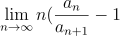
7. Raabe's Test


If ∑aₙ be a positive term series, then ∑aₙ converges if  and diverges if 
8. Gauss′s Test


If aₙ>0 and  , then ∑aₙ converges for μ>1 and diverges for μ≤1.

9. Logarithmic Test


If aₙ>0, then the series ∑aₙ

  •    converges if   and
  •    diverges if  

Sunday, 27 January 2019

Cauchy sequence

A Cauchy sequence is a sequence whose terms become very close to each other as the sequence go further. Cauchy sequence is helps in study of two topics
1. In real number
2. In metric space

Cauchy sequence


In real number


Definition:- A sequence {xₙ} is said to be Cauchy sequence if given ε>0, however small, ∃ a positive integer k(depending upon ε) such that
                  

Another definition:- A sequence {xₙ} is said to be Cauchy sequence if given ε>0, however small, ∃ a positive integer m(depending upon ε) such that
                

lim of a sequence
In given figure, we have taken n as subscript on x-axis and xₙ on y-axis. when n,m≥k, take  very close to 1 then  is very small number. This implies that the sequence is Cauchy sequence and converge to l.

Article 1:- Prove that a Cauchy sequence is bounded.
proof:  Let {xₙ} be Cauchy sequence.
        given ε>0, there exist a positive integer p such that
                
In particular, 
               
Now     


Let 
      | xₙ |≤M   ∀ n
⇒   {xₙ} is bounded

Article 2:- Prove that a convergent sequence is always a Cauchy sequence.
Proof: Let the sequence {xₙ} converge to l
          given ε>0, however small, ∃ k∈ℕ s.t
                
Let m≥k be a natural number.
                
Now    


             {xₙ} is a Cauchy sequence.

From artical2 it is clear that when ever a sequence is Cauchy sequence, it is convergent to.

In Metric space


Definition:- A sequence {pₙ} in a metric space X is said to be a Cauchy sequence if for every ε>0 there is an integer N such that   if n≥N and m≥N.
   
Definition:- Let E be a non empty subset of metric space X, and let S be the set of all real number of the form d(p,q), with p∈E and q∈E. The sup of S is called the diameter of E.
     If {pₙ} is a sequence in X and if Eₙ consist of the point   it is clear from the two preceding definition that {pₙ} is a Cauchy sequence if and only if
                           

Definition:- A metric space in which every Cauchy sequence converges is said to be complete.
         Thus every Cauchy sequence in E is a Cauchy sequence in X, hence it converge to some p∈X, and actually p∈E since E is closed. An example of metric space which is not complete is the space of all rational number, with d(x,y)=| x-y |.
         It shows that convergent sequence are bounded, but that bounded sequence in Rⁿ need not converge. However, there is one important case in which convergence is equivalent to boundedness; this happen for monotonic sequence in R¹.

Popular Posts

Categories

Contact Us

Name

Email *

Message *

Search This Blog

Recent Post

Popular Posts



